
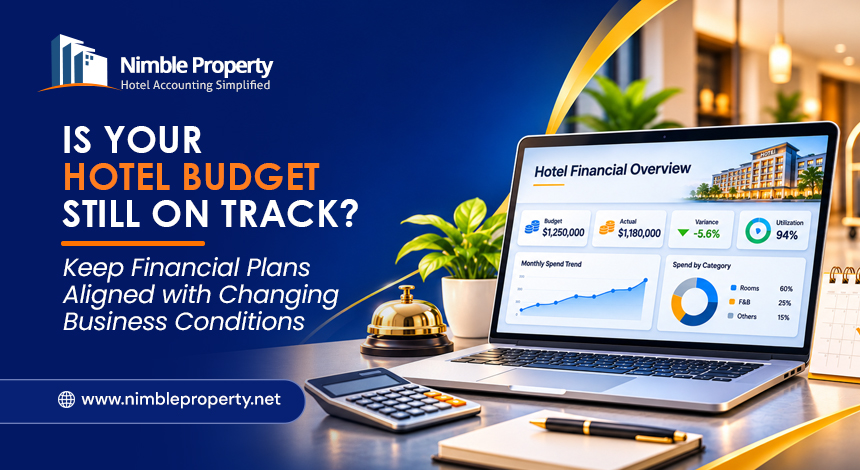
A hotel budget is only as good as its application to the business conditions it is meant to control.
For most hotels, preparing annual budgets takes a lot of time. Finance teams look at past performance, department heads submit estimates, management looks at revenue expectations, and corporate teams finalize the numbers. Once approved, the budget is the financial map for the year.
But there’s a problem. Business conditions seldom remain constant for an entire year.
The way in which buildings are occupied is changing. Businesses cancel or postpone group reservations. Increasing labour costs. Prices vary by retailer. The seasonal demand is not behaving the way it should. Unexpected expenses eat away at profits.
Picture a hotel that approved its 2027 budget in November 2026 with expectations of strong corporate demand, steady labour costs and a 12% increase in revenue. Three months later, corporate reservations have decreased, payroll costs are rising, and operating costs are higher than anticipated.
The original budget may still appear reasonable on paper, but does it accurately reflect the hotel’s current business situation?
More importantly, how soon can management find the gap and close it?
This is where ongoing financial monitoring is critical.
1. Does your Revenue Budget match your Real Business Performance?
Imagine a hotel with a $500,000 monthly revenue budget based on past performance and anticipated occupancy.
By midmonth the hotel has only taken in $180,000. At first management is hoping last minute bookings will help close the gap.
However, without information about future bookings, this assumption is difficult to validate.
The situation: Revenue is behind budget, but management doesn’t know if future demand will be strong enough to make up the shortfall.
What should management be looking at?
· Actual revenue versus budget and last year’s performance.
· Current occupancy and booking trends for the future.
· Activity of the pick-up for the last 1, 3, 7, 14 and 30 days.
· Performance by individual hotels and the total portfolio.
· Corporate account bookings patterns.
Nimble Analytics addresses this with its property overview and on-the-books (OTB) analytics.
Management can compare individual or group hotel performance to last year’s actuals and approved budgets. OTB analytics gives you visibility into future bookings, pickup activity, and comparisons across multiple corporate accounts.
This helps management to determine if the revenue gaps are temporary or a more significant change in demand.
Instead of waiting until month-end, the team can assess business performance while there’s still time to act.
2. Are labour costs rising faster than revenue?
Revenue growth doesn’t necessarily mean profit growth.
Imagine a hotel that achieves its revenue target for the month, but its labour costs are way over budget.
Increased departmental staffing, overtime, more shifts, and employee benefits can all rapidly lower operating margins.
The situation: Although revenue is growing as anticipated, the hotel’s profitability is decreasing due to labour costs that are higher than anticipated.
Management must answer several questions:
· Which departments are over budget for labour?
· Are overtime hours going up?
· Are salary, tax and benefit expenses growing disproportionately?
· Which properties are operating less efficiently?
· Is the increase of labour proportioned to the quantity of business?
Nimble Analytics offers labour analytics for departmental hours and amounts including salary, taxes and benefits breakdowns.
Finance and operations teams can compare actual departmental labour expenses against budgets and evaluate performance across properties.
Flex and flow-through analysis adds an additional important dimension: Management can understand how changes in revenue translate into changes in operating expenses and profits.
The goal is more than merely saving on labour. It is to determine whether staffing costs are reasonable given the hotel’s present level of business.
3. Do Vendor Payments and Operating Expenses Impact Your Financial Position?
Even if a hotel gets the budget right, controlling actual spending can be difficult.
For example, a property has an operating budget of $75,000 a month. But there are many vendor bills that come in at the same time, including maintenance contracts, food supplies, utilities, and outstanding debit memos.
Some invoices are still waiting for approval, and some are approaching their payment deadline.
The situation: Management can see the expense figures on the financial statements, but they don’t have immediate visibility into upcoming obligations and approval bottlenecks. Nimble Property’s Accounts Payable capabilities help finance teams manage this more effectively.
The AI-enabled OCR system captures vendor invoices and debit memos via manual, email, and mobile app uploads. The system includes automatic COA coding and approval-ready workflows.
Management can also track document activity using file logs to determine who shared the documents.
Vendor Centre provides a consolidated view of vendor operations, approvals, one-time payments, and vendor KPIs. Restricted vendor controls are used by management to enforce internal requirements.
The bill payment screen allows for multiple approvals, while electronic payment options include REPAY integration and customizable EFT exports.
Nimble Analytics allows management to keep track of outstanding payables, top dues, and upcoming payments.
This helps address a crucial question in budgeting: Are costs rising because of real business activity or because of shifting payment obligations and buying habits?
4. Do You Know How Much Cash You Really Have?
Profitability and cash flow are two different aspects. A hotel may report positive operating results despite being under cash flow pressure due to pending credit card collections, outstanding customer balances, or vendor payments.
The story: The hotel appears to be financially healthy, but the corporate finance team can’t be sure what the actual cash position is.
Management needs to see:
· Cash and credit card collections that are pending.
· Receivables by ledger aged.
· Delayed payments to vendors.
· Deposits of checks and cash.
· Bank transactions not reconciled.
For individual properties and hotel groups, Nimble Analytics offers specialized tracking for outstanding cash and card amounts, receivables, and payables.
The Daily Cash and Checks Deposit Manager adds operational control by enabling hotel teams to record daily collections, submit deposits for approval and track deposit status.
Direct journal entries assist in addressing shortages and overages and increase transparency between property and corporate teams.
Nimble’s enhanced bank feeds, powered by Mastercard Finicity, Plaid and MX, also increase bank connectivity and automatic synchronization.
Matching daily sales and open bills to payments also helps finance teams keep accurate financial records. These capabilities provide management with a means to assess if its cash flow assumptions are still reasonable.
5. Are you Reviewing your Financial Performance Often Enough?
One of the greatest challenges in hotel financial management is the lag between business activity and management visibility. If the corporate team only receives financial information after the month-end close, the opportunity to correct overspending or address revenue shortfalls may already be gone.
The scenario: A hotel consistently runs over budget on utility and departmental expenses, but management doesn’t recognize the pattern until the monthly financial review. Nimble Property solves this
visibility problem with customizable reporting and analytics. Daily Flash Report supports customized formats for individual hotels and groups, with automated email scheduling.
The Monthly AI Financial Analysis Report compares the financial data for the month to the historical performance and budgets and provides insights based on AI.
Management can also build customized trends and KPI widgets using COAs, statistical data and other relevant financial measures.
Balance Sheet, Profit and Loss KPIs give you another view of the property’s financial health.
Hotel groups can also access these insights through mobile-friendly Nimble Analytics, so management can review property and portfolio performance away from the office.
6. Are You Looking at External Market Conditions?
A hotel budget should not be evaluated solely based on its internal financial data. A property may underperform due to changing market demand, local events, competitor pricing, holidays or unexpected weather conditions. STR reporting and GSS reporting give further insight into market and guest satisfaction. Nimble supports automated weekly and monthly STR formats and analytics as well as automated GSS formats for Medallia and Qualtrics. These indicators, in conjunction with internal revenue, labour and expense data, allow management to determine if changes in performance are property specific or are affected by general market conditions.
7. Transition from Budget Approval to Ongoing Budget Management
The approved budget should be the starting point, not the end point, of financial management.
Hotel owners and corporate finance teams should routinely ask:
· Are our revenue assumptions still attainable?
· Are labour and operating costs moving in line with expectations?
· Are we on track to meet our future financial targets?
· Are receivables and payables outstanding affecting liquidity?
· How consistent are individual property performances?
· Are original expectations changing due to market conditions outside our firm?
Nimble Property brings together these financial and operational indicators through Accounts Payable, Nimble Analytics, Bank Feeds, Cash Management and Automated Reporting.
Thus, budget control is better informed, so that management can identify deviations earlier, analyse their causes, and take better actions.
For a hotel budget, what matters is not how accurately it was approved months ago. It is how well management can utilize it to guide decisions under today’s business conditions.
The budget needs to change with the business. Your financial visibility should evolve along with it.
What’s next for Nimble Property?
Nimble Property’s next development roadmap is focused on increasingly automated, predictive and connected hotel financial management.
Some of the key planned improvements include:
· AI Budgeting: Creation of budget including year-over-year trends, imported data and manual assumptions.
· AI Forecasting: Forecasts on a weekly and monthly basis that consider future bookings, historical data, events, weather, holidays, reviews and competitor occupancy.
AI Auto Reconciliation: AI-driven transaction categorization, matching, COA suggestions, reconciliation rules and reconciliation dashboards.
· Merchant Reconciliation: Three-way matching of daily sales, merchant batches and bank deposits with chargeback tracking.
· New Income Statement Builder: Multiple custom financial statement formats, formulas, comparisons and budget configurations.
· Forward STR: Competitive future-booking data and analytics.
Payroll and Timesheet Integrations: Departmental hours, overtime risk, payroll imports and budget vs actual labour analysis.
· Receipt & Expense Management: Upload receipts via email & mobile and post expense transactions.
· Ask Nimble AI: A conversational assistant that will provide answers to operational and financial questions, beginning with Accounts Payable, with additional analytics and support capabilities on the roadmap.
